1. Introduction
The continuous intraday market plays a critical role in the European electricity market by allowing market participants to adjust their positions closer to the time of delivery. While the Day-Ahead market establishes positions for the following day through an auction, the intraday market provides an additional opportunity to react to new information and optimize supply and demand as delivery approaches.
This flexibility is particularly important for integrating variable renewable energy sources. As weather forecasts become more accurate closer to real time, renewable generators can adjust their market positions to reflect expected changes in production. At the same time, consumers, utilities and traders can react to changing demand, generation outages and other unexpected events.
The continuous intraday market therefore acts as an important link between the Day-Ahead market and physical delivery, allowing market participants to continuously refine their positions as market conditions evolve.
2. Role in the Spot Market
Timeframe The intraday continuous market serves as the final adjustment before delivery. The delivery day is being traded in several contracts (hourly, half-hourly and quarter-hourly). Contracts can be traded up to 5 mins before the actual delivery, depending on the market.
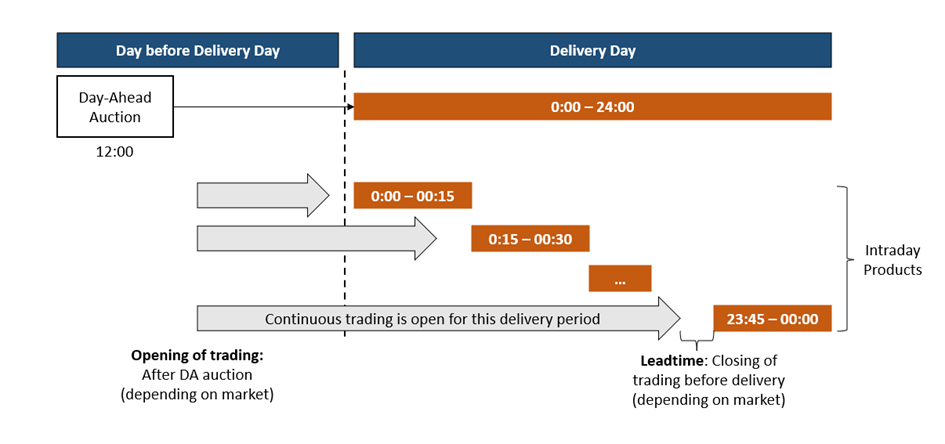
Graph: Spot Market timeline
Use cases and examples The intraday market, especially the intraday continuous market offers market participants the opportunity to adjust their production or consumption closer to the period of delivery, when more information is available.
Adjustment of PV production A PV farm sold all their forecasted production on the Day-Ahead market (12:00 CET the day before delivery) based on the weather forecast at that time. On the following day the weather forecasts become more accurate and change slightly. At 14:00 on the delivery day, the PV farm learns that the period 14:45 – 15:00 will be more cloudy than expected the day before, meaning that they cannot produce the volume they sold in the Day-Ahead auction. In order to balance out their position, the PV farm buys the “missing” volume on the intraday continuous market.
Power plant optimization A gas power plant has a certain amount of flexible capacity that they can adjust based on market prices. The power plant is constantly screening the continuous market looking for the highest prices possible to sell their production.
Trading companies Trading companies without physical generation or consumption assets can also participate actively in the intraday market. Rather than managing a physical position, these participants seek to generate returns from movements in electricity prices and differences between related contracts or markets.
Two important strategies are speculative trading and market making.
Speculative traders take directional positions based on an expectation that prices will move in a particular direction. These expectations can be based on updated forecasts, market fundamentals, weather information, renewable generation forecasts or other market signals.
Market makers, by contrast, provide liquidity by simultaneously placing buy and sell orders. Their objective is generally to capture the difference between the bid and ask prices while actively managing the risks associated with the positions they accumulate.
For trading companies without physical assets, positions typically need to be managed and ultimately closed or balanced before delivery, as the trader does not have physical generation or consumption.
Development The continuous intraday market has experienced significant growth in recent years. Increasing liquidity makes it easier for both physical and financial participants to enter and exit positions, which can in turn attract additional market participants and further support liquidity.
The growth of intraday trading also reflects the increasing need for flexibility in electricity markets, particularly as the share of weather-dependent renewable generation increases.
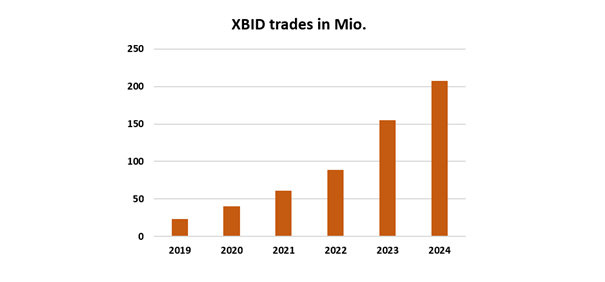
Graph: XBID trades per year XBID refers to all coupled intraday markets in Europe
Source: https://www.entsoe.eu/network_codes/cacm/implementation/sidc/#market-information
3. Market Design
The intraday electricity market operates on a continuous trading mechanism, allowing market participants to adjust their positions in real-time up until just before delivery. Unlike the Day-Ahead market, which is based on auctions, the intraday market enables trading on a first-come, first-served basis.
The graph below illustrates a real-time order book update for a contract of electricity between 17:00-18:00 with delivery in France (RTE balancing area).
At 15:37, the order book consists of existing buy and sell orders, with the best available buy price at 80.91 €/MWh and the lowest sell price at 81.70 €/MWh. At this moment the sellers and buyers offers do not allow for a trade.
At 15:41, a new sell order for 1.2 MWh at 80.91 €/MWh is placed into the market, matching the highest buy offer. This results in an immediate trade execution at 80.91 €/MWh for 1.2 MWh, reducing the available volume of the corresponding buy order.
By 15:42, the updated order book reflects this trade, with the remaining buy order volume reduced from 4 MWh to 2.8 MWh at the same price. The next best sell offer now stands at 81.70 €/MWh.
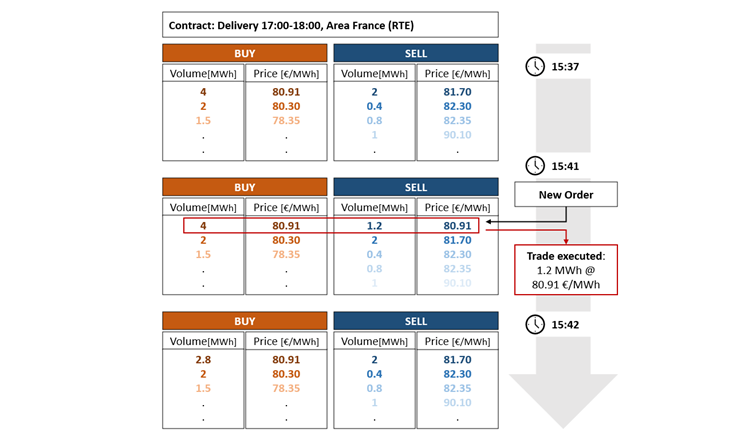
Graph: Example of the trade execution of a market order
Order types Market participants can express their trading intentions through several different order types. Some of the most common examples include:
Market Order An order to buy or sell immediately against the best available prices in the order book.
Limit Order An order that is executed only at the specified price or a more favorable price. The order is placed in the order book until it is executed, cancelled or expires.
Iceberg Order A limit order where only part of the total volume is displayed to the market. The remaining volume becomes visible progressively as the displayed volume is executed.
Block Order An order or group of linked orders that is subject to specific execution conditions and can, depending on the product and market rules, require the associated volumes to be executed together.
The availability and precise functionality of order types depend on the relevant market and trading platform.
4. Market Coupling and Cross-border Trading
Market Coupling Continuous intraday trading is integrated across European markets through the Single Intraday Coupling (SIDC) framework. This allows market participants to trade across connected bidding zones while making use of available cross-border transmission capacity. Market coupling is an important feature of the European intraday market because it enables liquidity to be shared across borders rather than requiring each bidding zone to operate as an isolated market.
Shared Orderbook Within the coupled market, orders submitted through participating exchanges are integrated into a shared order book. From the perspective of market participants, the order book provides access to the available liquidity regardless of which participating exchange originally received a particular order. Orders are anonymized and matched according to the applicable matching rules and available cross-border capacity.
This integration allows the most competitive available orders to interact across participating markets.
Cross-border trading Cross-border trading enables electricity to flow between bidding zones when available transmission capacity allows trades to be matched across borders.
For example, if electricity is available for purchase at a lower price in one bidding zone and a corresponding sell order exists in another zone, available cross-border capacity can enable the transaction to be executed between the two markets.
The resulting trade can lead to an import into one bidding zone and an export from another. In this way, cross-border intraday trading contributes to the efficient use of available transmission capacity and helps market participants manage differences between their expected positions in different markets.
5. Conclusion
The continuous intraday market has become an increasingly important component of the European electricity market. It provides market participants with the flexibility to adjust their positions as delivery approaches and as new information becomes available.
For renewable generators, it provides an important tool for managing forecast deviations. For flexible generators and consumers, it creates additional opportunities to optimize their positions. For trading companies, it provides opportunities for both directional trading and liquidity provision through market making.
The continued development of liquidity and cross-border integration further strengthens the role of continuous intraday trading in the European power market. As electricity systems become increasingly dependent on variable renewable generation, the ability to continuously adjust positions close to delivery is likely to remain an essential feature of the market.